Roulette Unblocked - Free Browser Simulator
Practice European table play instantly with virtual chips, no account, no download and no real-money balance.
Roulette Simulator Facts
- Game type: European single-zero roulette
- Balance: Virtual chips only
- Real-money gambling: Not available
- Download: Not required
- Account: Not required
- Main use: Practice, rules learning and strategy testing
This free browser demo lets you spin the wheel, place virtual chips on the table, and learn the game through direct practice. It is built for users who want to understand bet placement, payout logic and game flow without creating an account or risking real money.
The tool uses a single-zero European wheel model and runs directly in your browser. There are no registration forms, no app store redirects, no credit card prompts and no software installation. You open the page, start the simulator and practise the basic sequence: choose a bet, spin, check the result and review the payout.
Scroll up to the game window above, place your virtual chips, and spin the wheel.
Start With Virtual Chips
The demo uses virtual chips only. That means you can repeat rounds, compare bet types and test simple systems without a cash balance. This makes the page useful as a practical trainer, not a real-money gambling product.
Because everything runs inside the webpage, the simulator works on modern browsers such as Chrome, Firefox, Safari and Edge. It is designed as a lightweight HTML5 experience with no external account layer and no download requirement.
For most users, this means:
- No install required: Use the same URL on desktop, laptop, tablet or mobile.
- No account required: Start with virtual chips without email verification.
- No real-money balance: The chips are for practice only and have no cash value.
🔒 Note About Boss Mode
Boss Mode is a visual privacy feature that temporarily replaces the simulator view on your own screen. It does not bypass network rules, workplace policies, monitoring systems or browser logs. Use it only as a screen-view toggle, not as a way to hide activity from systems you do not control.
What This Tool Does
This browser tool provides free practice with a European-style table. You can place simulated bets, start a spin, watch the result and see how the game settles winning and losing positions.
The main purpose is learning. If you are new to the game, the simulator gives you a visual way to understand the table before reading a full rules explanation. For a deeper walkthrough, use our beginner guide to roulette rules.
The page is also useful for testing ideas. You can compare flat betting, outside bets, inside bets and progression systems before using the dedicated strategy testing tool.
Benefits of Risk-Free Practice
A practice environment helps users learn the game structure without financial pressure. Instead of reading theory only, you can repeat the same actions until the table layout, chip positions and payout sequence become familiar.
- Practise in a safe environment.
- Understand bet types by testing them directly.
- See how the table and wheel interact during each round.
Many beginners struggle because the table looks crowded at first. Direct practice solves that problem. You can place one chip, see what it covers, spin the wheel and observe the outcome without needing a live dealer or real balance.
How a Round Works
A round follows a fixed sequence. The player selects one or more positions on the table, the wheel produces a result, and the game settles the bets according to standard payout rules.
The gameplay sequence is:
- Place chips on the table
- Start the spin
- Wait for the ball to settle in a pocket
- Confirm the winning number
- Pay winning positions based on the selected bet type
- Remove losing positions from the table
This same structure applies to physical tables, live dealer formats and digital practice games. The difference here is that the full process is simulated with virtual chips.
Anatomy of the European Wheel
The wheel produces the final result. A European wheel has 37 pockets: numbers 1 to 36 plus one green zero. The single zero is what creates the mathematical house edge.
The wheel layout includes:
- Numbered pockets from 1 to 36
- Alternating red and black pockets
- One green zero pocket
- A fixed pocket order that differs from the betting grid
The order on the wheel is not the same as the number order on the table. This matters because the wheel determines outcomes, while the table defines bet coverage. Users who understand both layouts can read the game more clearly.
Table Layout and Bet Placement
The table is the betting surface. It contains the number grid, outside betting areas, dozens, columns and zero section. Every chip position maps to one or more possible wheel outcomes.
The betting grid includes:
- A main grid for numbers 1 to 36
- A zero area
- Red/black, odd/even and high/low boxes
- Dozen sections
- Column sections
When you place chips on numbers, lines, corners, dozens or outside areas, you are choosing which outcomes will count as winning results. For exact payout values, use the odds and payout chart.
Inside and Outside Bets
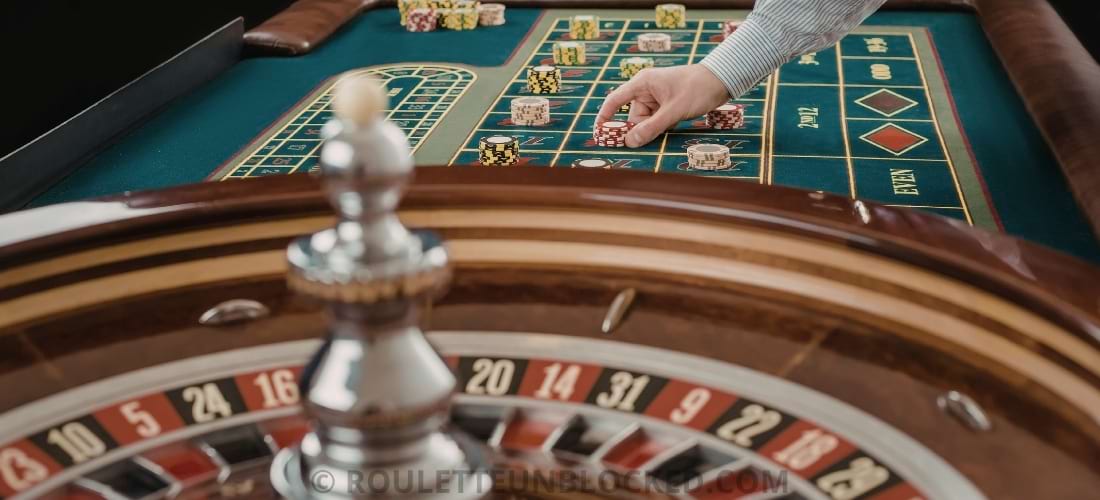
Bet types are usually divided into two groups. Inside bets cover single numbers or small groups of numbers. Outside bets cover larger categories, which makes them hit more often but pay less.
Inside Bets
Inside bets are placed on the main numbered grid. They focus on precise number coverage and offer higher payout odds with lower hit frequency.
Here are the main inside bets and their standard payouts:
- Straight Up: Betting on a single number. Pays 35:1.
- Split: Betting on two adjacent numbers. Pays 17:1.
- Street: Betting on three numbers in a horizontal row. Pays 11:1.
- Corner: Betting on four connecting numbers. Pays 8:1.
- Six Line: Betting on six numbers across two adjacent rows. Pays 5:1.
Outside Bets
Outside bets are placed in the boxes around the main grid. They cover broader groups of outcomes and are often easier for beginners to understand.
Here are the main outside bets and their standard payouts:
- Red / Black: Betting that the ball lands on a red or black pocket. Pays 1:1.
- Odd / Even: Betting that the result is odd or even. Pays 1:1.
- High / Low: Betting on 1-18 or 19-36. Pays 1:1.
- Dozen: Betting on a block of 12 numbers. Pays 2:1.
- Column: Betting on one vertical column of 12 numbers. Pays 2:1.
Dealer Logic and Automated Settlement
At a physical table, the dealer spins the wheel, releases the ball, manages bets, closes the betting phase and settles the result. In this browser version, the software performs those steps automatically.
The automated system handles:
- Starting the spin
- Generating the result
- Checking active chip positions
- Applying standard payout rules
- Updating the virtual balance
This gives users full control over practice speed. You can repeat rounds quickly, pause whenever needed and focus on one bet type at a time.
Single-Zero vs Double-Zero Wheels
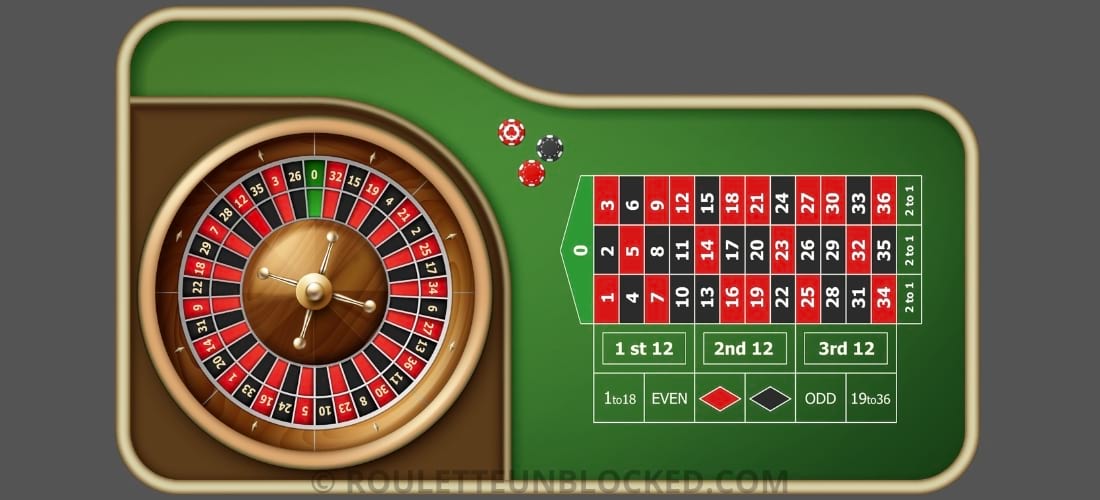
The main difference between European and American versions is the number of zero pockets. A single-zero wheel has 37 pockets. A double-zero wheel has 38 pockets. That extra pocket changes the house edge and long-term return.
European Version
The European wheel uses one zero and 36 numbered pockets. Because there is only one zero, it has a lower house edge than the American version.
This is the version used for the main simulator on this page.
American Version
The American wheel uses one zero, one double zero and 36 numbered pockets. The extra double-zero pocket increases the casino advantage because standard payouts do not change.
That is why double-zero play is less efficient from a mathematical point of view.
French Rules and Even-Money Bets
French-style tables are closely related to European play because they also use a single zero. The important difference is the La Partage or En Prison rule on even-money bets. When these rules apply, the effective house edge on red/black, odd/even and high/low can be reduced to 1.35%. Straight-up and other inside bets still use the standard single-zero edge.
RTP and House Edge
RTP and house edge describe the mathematical structure of the game. House edge is the built-in advantage for the casino. RTP is the expected return to the player over a very large sample of spins.
The zero pocket creates the gap between true odds and payout odds. Even-money bets do not include zero as a winning category, which is why the game has a long-term mathematical edge.
Standard figures are:
| Metric | Figure |
|---|---|
| European house edge | 2.7% |
| American house edge | 5.26% |
| European RTP percentage | 97.3% |
| American RTP percentage | 94.74% |
House Edge in Plain Terms
House edge is not a prediction for one spin. It is a long-run property of the wheel and payout structure. A short session can end above or below expectation, but the underlying math does not change.
If the house edge is 2.7%, the game is structured to return slightly less than the total amount wagered over a very large number of rounds. The difference comes from the zero pocket and the fixed payout rules for each bet type.
Return to Player Explained
RTP means return to player. It expresses the same system as house edge, but from the player’s side. A 97.3% RTP corresponds to a 2.7% house edge.
This figure is useful when comparing single-zero and double-zero formats. It also helps explain why betting systems can change short-term balance movement without changing the expected value of the game.
Betting Systems You Can Test
Betting systems are structured ways to change or repeat stake size across rounds. Many users test these systems in practice mode because it shows how quickly stake size, balance swings and losing streaks can develop. For a more detailed tool, use our roulette strategy tester.
Martingale
Martingale doubles the stake after each loss. The goal is to recover earlier losses with one later win. It is useful to test because losing streaks can make required stake size grow very quickly.
Fibonacci
Fibonacci uses a sequence-based stake pattern. The player moves forward after a loss and back after a win. It increases stakes more slowly than Martingale.
D’Alembert
D’Alembert adds one unit after a loss and subtracts one unit after a win. It is a slower progression and often used to study moderate balance movement.
Reverse Martingale
Reverse Martingale increases the stake after a win instead of after a loss. It reacts to winning streaks instead of trying to recover losses immediately.
Labouchère Strategy
Labouchère is a cancellation system. The player writes a target sequence, stakes the sum of the first and last number, removes numbers after wins and adds the lost stake after losses.
Flat Betting
Flat betting uses the same stake on every round. It is useful as a baseline because the outcome pattern is not affected by changing bet size.
Learn by Repetition
The fastest way to understand the table is to repeat the same sequence several times: choose a position, spin, check the winning number and review the payout. This makes the rules easier to absorb than reading definitions alone.
The visual layout also helps users understand bet coverage in context. The number grid, chip positions and result pattern stay visible during play, which makes the game easier to read.
Practice Without Financial Exposure
Virtual chips remove the financial layer while keeping the basic mechanics visible. You can reset, repeat and compare different choices without loss exposure.
This is especially useful for beginners who want to understand the difference between inside bets, outside bets, even-money bets, dozens, columns and number-specific coverage before considering any real-money environment.
Compare Different Betting Approaches
Practice mode lets you apply different approaches to the same game structure. You can compare outside bets, inside bets, flat betting and progression systems under repeatable conditions.
This does not change odds, RTP or house edge. It simply gives you a controlled environment where different betting sequences can be observed without real-money consequences.
How the Simulator Engine Works
A practice tool is only useful if it behaves consistently. RouletteUnblocked.com uses browser-based game logic reviewed by Editor-in-Chief Kim Birch to keep the simulation aligned with standard single-zero mechanics.
Random Number Generation
The engine uses browser-native random values, including crypto.getRandomValues where supported, to generate spin outcomes. You can read more about the process on our RNG methodology page.
- The result is not based on your stake size.
- The wheel has no memory of previous spins.
- The virtual balance does not influence the next outcome.
The purpose is educational accuracy. The simulator should help users observe probability, variance and payout structure without presenting the game as a way to predict future results.
Useful Table Terms
A few terms appear often in guides and game interfaces. Knowing them makes the table easier to understand.
- Bankroll: Your available play-money balance. In this simulator, it is virtual and has no cash value.
- Croupier: The formal name for the dealer. In this demo, the software performs the dealer function.
- Inside bets: Bets on specific numbers or small number groups.
- Outside bets: Bets on broader groups such as red/black, odd/even, high/low, dozens and columns.
- House edge: The mathematical advantage created by the zero or double zero.
- Racetrack: An oval betting layout based on wheel order rather than table-grid order.
For a fuller explanation of rules, bet types and table etiquette, read the complete beginner guide.
Frequently Asked Questions
Yes. The simulator uses browser-based random number generation to produce spin outcomes. It is not designed to make users win or lose based on balance, stake size or previous results.
No. RouletteUnblocked.com is strictly a free-to-play educational simulator. The chips have no monetary value, and there are no prizes. If you choose to gamble elsewhere, use only regulated operators in your jurisdiction and follow legal age requirements.
Boss Mode temporarily replaces the visible simulator area with a neutral-looking screen. It is only a visual toggle on your own display. It does not bypass network policies, monitoring tools, workplace rules or browser logs.
Yes. The site can use your browser's Local Storage to remember your virtual chip balance. If you clear browser data, reset the session or use another device, the saved balance may disappear.
No. The site is built for modern browsers. Open it in Chrome, Safari, Firefox or Edge and the layout will adapt to your screen size and touch controls.
Start Practising Instantly
You do not need a credit card, username or download. Open the table, use the virtual chips and repeat as many rounds as you need to understand the game flow.
Scroll Up & Place Your Bets
Virtual Chips • No Credit Card Required • Instant Browser Play